In modern industries such as food processing, pharmaceuticals, textiles, and hospitality, industrial boilers play a critical role as the “heart” that supplies heat and steam to the entire system. However, they are also among the high-risk industrial thermal equipment if operated incorrectly.
According to pressure equipment safety standards, most incidents related to industrial boilers originate from operational errors or a lack of proper control procedures. Especially for beginners, the absence of a clear checklist can easily lead to dangerous situations such as low water levels, overpressure, or equipment failure.
This article provides a comprehensive industrial boiler operation checklist, organized into three stages: before – during – after operation, helping businesses ensure safety, stability, and cost optimization.
1. Overview of Industrial Boiler Operation for Beginners
1.1. What is an industrial boiler?
Industrial boilers are devices that use heat to convert water into high-pressure steam, serving production and heating processes. They are a common type of industrial thermal equipment used across various industries.
Common types of boilers today include:
- Electric industrial boilers (electric boiler)
- Oil- and gas-fired boilers
- Biomass-fired boilers
- Circulating fluidized bed boilers
Each type has different operating characteristics but all require strict control procedures.
>> Related article: What is an industrial boiler? Mechanism & applications
1.2. Why is an operation checklist necessary?
Unlike many standard machines, industrial boilers operate under high pressure and temperature, so even a minor mistake can lead to serious consequences.
An operation checklist helps to:
- Ensure operator safety
- Maintain stable performance
- Reduce fuel consumption
- Extend equipment lifespan
- Comply with inspection and regulatory requirements
According to thermal engineering guidelines, implementing a checklist can reduce operational incidents by up to 30–40% in industrial facilities.
1.3. Applications of industrial boilers across industries
Industrial boilers are widely used in various sectors:
- Food & beverage industry: sterilization, cooking, steaming
- Textile industry: dyeing, drying, ironing
- Pharmaceutical industry: equipment sterilization, drug production
- Chemical industry: thermal reactions, heating processes
- Hospitality & laundry services: hot water and steam supply
- Wood and paper processing industry: drying and material treatment
2. Pre-operation checklist for industrial boilers
2.1. Check the feedwater system
The water system is a critical factor in industrial boiler operation. Before startup, it is necessary to check:
- Whether the water level in the sight glass meets the standard level
- Stable operation of the feedwater pump
- No leaks in the system
In addition, water quality must be properly treated according to standards:
- Removal of impurities
- Water softening
- Oxygen removal (deaeration)
Using untreated water can cause scaling, reduce efficiency, and even lead to equipment damage.
2.2. Check the safety system
Safety devices must be carefully inspected:
- Whether the safety valve is functioning properly
- Accuracy of pressure and temperature gauges
- Normal operation of the alarm system
This is a critical protection layer to prevent dangerous incidents such as boiler explosions.
2.3. Check the fuel system & combustion chamber
Depending on the type of industrial boiler, the following checks are required:
- For electric industrial boilers: electrical system, wiring, and control cabinet
- For oil/gas boilers: pipelines, valves, and fuel supply
Additionally:
- Ensure no obstructions inside the combustion chamber
- Ensure there are no fuel leaks
2.4. Check the control system
- PLC / SCADA systems operate stably
- Pressure and temperature sensors provide accurate readings
- Automatic shutdown system activates during overload conditions
3. Checklist during boiler operation
3.1. Continuously monitor operating parameters
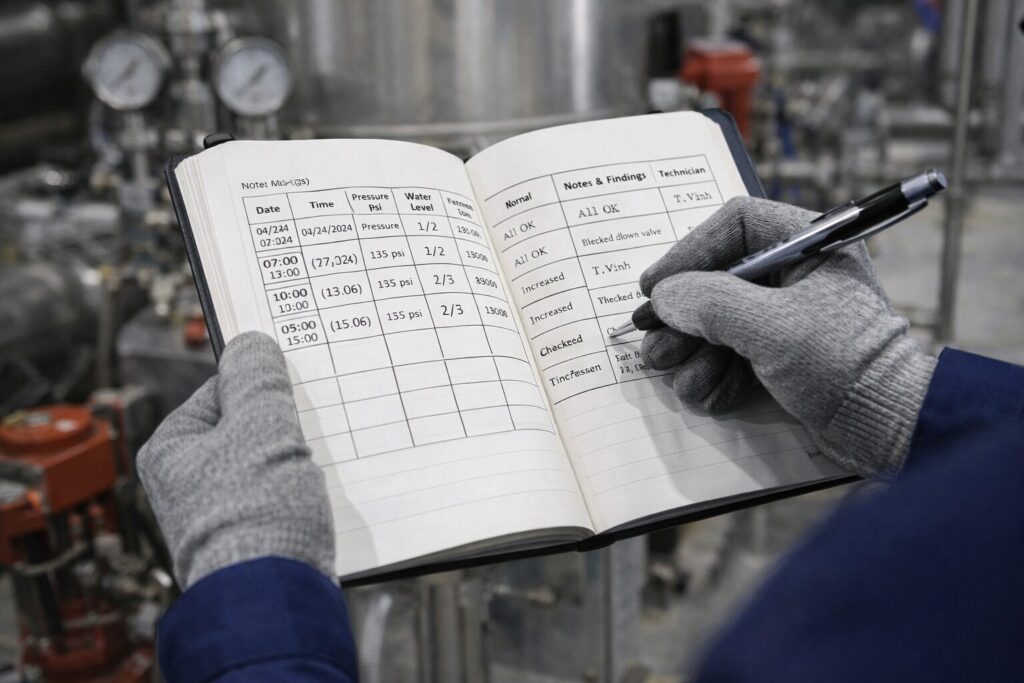
During operation, it is necessary to monitor:
- Steam pressure
- Temperature
- Water level
These parameters must remain within allowable limits. If they exceed the threshold, immediate action is required to prevent incidents.
3.2. Perform periodic checks during the shift
Operators should:
- Inspect equipment every 1–2 hours
- Record parameters in the operation logbook
- Detect abnormal signs early
For example:
- Abnormal vibrations
- Unusual noise
- Steam or water leakage
3.3. Adjust load and fuel appropriately
To optimize performance:
- Adjust fuel input appropriately
- Avoid overloading
- Maintain stable capacity
This helps save energy and reduce operating costs.
3.4. Ensure operator safety
- Always have personnel on duty
- Do not leave the system unattended while operating
- Use full personal protective equipment (PPE)
This is a critical factor in managing industrial thermal equipment.
4. Checklist for boiler shutdown and maintenance
4.1. Proper boiler shutdown procedure
Shutting down an industrial boiler must follow a proper sequence:
- Gradually reduce load
- Stop fuel supply
- Allow natural cooling
- Drain water if necessary
Avoid sudden shutdowns, as they may cause thermal shock and crack tubes.
4.2. Periodic maintenance
Maintenance tasks include:
- Cleaning the combustion chamber
- Blowdown (removal of sludge and scale)
- Inspecting valves and sensors
Maintenance helps to:
- Extend equipment lifespan
- Maintain performance
- Reduce repair costs
>>> Related article: Daily/Weekly/Monthly Boiler Maintenance Checklist
4.3. Inspection and legal compliance
According to regulations:
- Boilers must undergo periodic inspections
- Safety valves must be regularly tested
- Operation records must be maintained
👉 These are mandatory requirements for all industrial boilers.
5. Common boiler operation mistakes and how to prevent them
5.1. Common mistakes
Some typical errors include:
- Low water level → risk of boiler explosion
- Malfunctioning safety valve
- Rapid temperature increase
- Lack of periodic inspection
These issues often occur when the checklist is not properly followed.
5.2. Effective prevention methods
- Strictly apply operational checklists
- Provide proper operator training
- Implement automation systems
According to industry reports, automation significantly reduces operational errors.
5.3. Optimal solutions for businesses
To improve efficiency, businesses should:
- Use electric industrial boilers for clean environments
- Apply automated control systems
- Select equipment suitable for production scale
>>> Related article: Comparison of electric, oil-fired, and gas boilers: Choosing the right solution for your business
6. Conclusion
Operating an industrial boiler is not simply about turning equipment on and off, but a process that requires precision, control, and strict compliance. An operation checklist helps businesses reduce risks, optimize performance, and ensure long-term safety.
In the context of rising energy costs and increasingly stringent production requirements, selecting the right boiler solution is a key factor in enhancing competitiveness.
👉 Contact Maruse Engineering for consultation on the most suitable boiler solutions for your business.
We provide:
- Optimized industrial boiler solutions
- Energy-saving systems
- Professional operation and maintenance consulting