1. Overview of the role of industrial boilers in the electronics industry
In the context of the electronics industry increasingly requiring high precision, supporting equipment such as boilers no longer plays just an auxiliary role but has become a decisive factor affecting product quality.
1.1 What is an industrial boiler?
Industrial boiler is a device that converts energy (electricity or fuel) into high-pressure steam to serve production processes. In other words, it is the “central steam supply source” for the entire factory system.
In modern factories, boilers are not only heat-generating devices but also serve as core industrial thermal equipment, directly affecting the stability of the production line.
Currently, common types include:
- Electric industrial boilers (Electric Boiler) – suitable for clean environments
- Gas/oil-fired boilers – high capacity
- Clean Steam Generators – used in high-standard industries
Choosing the right type of boiler from the beginning will help businesses optimize long-term operating costs.
1.2 Why does the electronics manufacturing industry need steam?
The electronics industry has unique characteristics that other industries do not, especially the requirement for an extremely stable and clean environment.
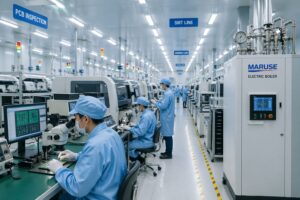
Manufacturing processes such as PCB (Printed Circuit Board), SMT (Surface Mount Technology), and semiconductor chip production all require dust-free environments (cleanrooms), precisely controlled humidity, and no contaminants.
Steam from industrial boilers is used to:
- Flexibly regulate air humidity
- Clean components and equipment without causing damage
- Sterilize the production environment
Without proper control, even a small deviation can lead to mass defects, increasing costs and affecting business reputation.
1.3 New trends (2024–2026) in the boiler industry
In recent years, the boiler industry has undergone many changes to align with modern manufacturing trends.
- Clean Steam has become the standard in high-tech manufacturing
- Electric industrial boilers are prioritized because:
- No emissions
- Compliant with ESG standards
- Application of IoT & automation:
- Real-time remote monitoring
- Energy consumption optimization
These trends not only help businesses save costs but also enhance their competitiveness in the international market.
2. Applications of boilers in cleanroom humidity control
Humidity is an “invisible” factor but has a direct impact on the quality of electronic components, especially in cleanroom environments.
2.1 The role of humidity in electronics manufacturing
In electronics manufacturing, humidity is not just an environmental parameter but a key factor determining product stability.
- Low humidity → static electricity → damage to microcircuits
- High humidity → condensation → corrosion of components
The standard humidity level is typically: 40% – 60% RH.
Maintaining this level continuously and accurately is a major challenge for many factories.
2.2 Principle of humidity control using steam
A steam-based humidity control system operates on a simple yet highly effective principle:
- The industrial boiler generates steam
- Steam is supplied into the HVAC system
- It is dispersed into the air to regulate humidity
With this mechanism, factories can:
- Quickly adjust when humidity changes
- Maintain a stable production environment
This is a commonly used solution in modern electronics factories.
2.3 Why use electric industrial boilers for cleanrooms?
In cleanroom environments, the “cleanliness” factor is the top priority, so equipment selection must meet strict standards.
Electric industrial boilers offer outstanding advantages:
- No emissions → no environmental pollution
- No dust generation → ensures cleanliness
- Precise control → suitable for automated systems
As a result, businesses can control the production environment more stably and safely.
3. Application of steam cleaning for components (Steam Cleaning)
In addition to humidity control, component cleaning is another important application of boilers in the electronics industry.
3.1 Why is steam cleaning necessary?
During the production process, electronic components are easily contaminated with grease, fine dust, and chemical residues.
Steam from industrial boilers helps to:
- Deep clean without causing scratches
- Eliminate the need for strong chemicals
- Ensure product safety
This is especially important for high-precision components.
3.2 Clean steam vs conventional steam
Not all types of steam are suitable for the electronics industry.
- Conventional steam: may contain impurities
- Clean steam: treated → ensures no contamination impact
Therefore, modern factories are shifting to the use of clean steam (clean steam) to ensure product quality.
3.3 Practical applications in electronics factories
Steam is applied in many processes:
- PCB cleaning
- Cleaning production molds
- Cleaning production lines
As a result, businesses reduce product defects and improve production stability.
4. Selecting the right industrial boiler for electronics factories
Choosing the right boiler not only affects performance but also directly impacts long-term operating costs.
4.1 Key selection criteria
When selecting an industrial boiler, it is necessary to consider:
- Steam quality
- Stability
- System integration capability
These are the factors that determine actual operational efficiency.
4.2 Electric industrial boilers – the optimal solution
Compared to other types, electric industrial boilers offer many advantages:
- High efficiency
- No emissions
- Easy operation
This is why more and more electronics factories are choosing this solution.
4.3 System design based on demand
Each factory has different requirements, so there is no “one-size-fits-all” solution.
Calculations should be based on: production scale & usage capacity.
Proper design from the beginning will help save long-term costs.
5. Applications of industrial boilers in other industries
Not only playing a key role in the electronics industry, industrial boilers are also essential equipment in many other manufacturing sectors where a stable and continuous heat source is required. In the food & beverage industry, boilers are used for processes such as sterilization, cooking, and steaming, ensuring hygiene and product quality.
In the textile industry, steam is used for fabric softening, dyeing, and finishing processes, requiring a stable steam supply to ensure consistent quality.
In the chemical industry, boilers support heating, distillation, and chemical reactions, requiring operation at high pressure and temperature.
In addition, in the medical and pharmaceutical sectors, clean steam from boiler systems is used to sterilize equipment and production environments, where quality standards are extremely strict.
It can be seen that in any industry, industrial boilers or electric industrial boilers play the role of the “heart” of the production system, helping businesses maintain stable performance and ensure product quality.
>>>Related articles:
Electric boilers in the pharmaceutical industry: Standards & applications
Boiler applications in the food industry: Standards & operational efficiency
6. Conclusion
It can be seen that industrial boilers play an important role in:
- Humidity control
- Component cleaning
- Production stability
In particular, electric industrial boilers are a suitable trend for modern factories.
This is not only a technical solution but also a factor that helps businesses enhance their competitiveness.
Contact Maruse Engineering for consultation on the most suitable boiler solution for your factory.
We accompany businesses in:
- Optimizing operations
- Improving product quality
- Moving toward sustainable production