As factories increasingly focus on production safety, energy savings, and compliance with international customer requirements, understanding the standards applied to industrial boilers has become more important than ever. These standards are not only legal requirements but also help businesses reduce operational risks and optimize long-term costs.
1. Why Are Industrial Boiler Safety Standards Becoming Increasingly Important?
In addition to supplying steam for production, industrial boilers are also equipment that operate continuously under high pressure and high temperature. Even a small mistake in design or operation can lead to serious incidents affecting the entire factory.
Especially in the food, pharmaceutical, or electronics industries, steam quality directly affects the quality of finished products. Therefore, complying with safety standards not only protects people but also helps ensure production quality.
1.1 Risks When Boilers Do Not Meet Standards
These risks often do not appear immediately but accumulate over time. As a result, many businesses only discover problems when equipment has seriously deteriorated or unexpected incidents occur.
Occupational safety risks
This is one of the top risks in every manufacturing plant. An incident involving high-pressure steam can significantly affect operators and the surrounding production area. High steam pressure combined with high temperature can cause severe burns or occupational accidents if leakage or equipment explosion occurs.
Production line shutdown
In many factories, the steam system is considered the “heart” of the production line. When steam supply is interrupted, many downstream processes must also stop, causing major losses in both time and cost.
Increased operating costs
Operating non-standard equipment often causes heat exchange efficiency to decline over time. This increases fuel consumption and leads to unplanned maintenance costs.
Failure to meet customer requirements
More and more FDI enterprises require suppliers to prove compliance with technical and safety standards. This is also one of the factors considered when evaluating a factory’s production capability.
2. How Are ISO Standards Applied to Industrial Boilers?
ISO is considered a common language for quality and safety in the global industrial environment. Applying ISO standards helps businesses easily align their management systems with international partners.
2.1 ISO 16528 – International Standard for Pressure Equipment
ISO 16528 focuses on:
- Design requirements
- Manufacturing
- Quality inspection
- Safety assessment
- Risk management of pressure equipment
Although it does not provide detailed regulations for each specific type of boiler, ISO 16528 sets out fundamental principles to help ensure that equipment operates safely throughout its service life. This is an important reference basis for design, manufacturing, and inspection organizations.
For food, chemical, or pharmaceutical factory projects with foreign investment, this standard is often used as a reference basis when selecting industrial boiler suppliers.
2.2 ISO in Steam System Quality Management
In addition to equipment standards, businesses commonly apply:
- ISO 9001 (Quality Management)
- ISO 14001 (Environmental Management)
- ISO 45001 (Occupational Health and Safety)
These systems help improve management efficiency. In practice, the efficiency of a steam system depends not only on the boiler itself but also on the overall operation management process. Combining ISO standards helps businesses build a stable production system and reduce potential risks.
2.3 Benefits of Applying ISO Standards
In addition to safety, ISO standards also help businesses build a professional image in the eyes of customers and partners. This is an important competitive advantage for companies participating in global supply chains.
More specifically, when a business has ISO certification, it can gain the following benefits:
- Improved system reliability
- Reduced accident risk
- Extended equipment lifespan
- Easier compliance with international customer requirements
- Enhanced product export capability
3. Japanese JIS Standards and Their Role in FDI Factories
Japan is a country with very high requirements for the stability and lifespan of industrial equipment. Therefore, JIS standards are often highly valued in manufacturing investment projects with strict quality requirements and are among the key standards considered when selecting a boiler system.
3.1 JIS B 8201 – Boiler Design and Manufacturing Standard
This standard helps ensure that the pressure-bearing parts of boilers are designed with an appropriate safety factor. Specifically, this standard regulates:
- Boiler body structural requirements
- Manufacturing materials
- Pressure resistance capability
- Inspection requirements before use
As a result, equipment can operate stably over a long period and minimize the risk of incidents.
3.2 JIS B 8223 – Feedwater Quality Standard
Many people focus only on the equipment but overlook feedwater quality. In many cases, boiler damage originates from feedwater quality rather than equipment defects. Proper feedwater control according to standards helps significantly reduce the risk of scaling, corrosion, reduced heat exchange efficiency, increased fuel consumption, and extends the system’s lifespan.
3.3 Why Do Many Japanese Factories Prioritize JIS Standards?
In addition to safety, JIS standards also focus on long-term operating efficiency and low ownership costs. This is why many Japanese companies view investment in standard-compliant equipment as a long-term cost-saving strategy.
This is also why many factories in Vietnam choose boiler systems developed according to Japanese standards.
4. Regulations on Industrial Boilers in Vietnam
Businesses operating in Vietnam must not only meet technical requirements but also comply with legal regulations on occupational safety and pressure equipment. This is a mandatory responsibility of the equipment owner and operator.
4.1 TCVN 12728:2019 – The Most Important Standard
TCVN 12728:2019 regulates:
- Design
- Manufacturing
- Installation
- Operation
- Boiler repair
This standard is currently an important basis for inspection organizations to evaluate the safety level of the system. Compliance with TCVN helps businesses reduce legal and operational risks.
4.2 Boiler Safety Inspection
Businesses need to carry out:
- Initial inspection: Before being put into use.
- Periodic inspection: In accordance with regulations of the competent authorities.
- Extraordinary inspection: After major repairs or structural changes to the equipment.
Periodic inspection should not be viewed merely as a mandatory procedure. It is also an opportunity for businesses to assess the actual condition of the equipment and detect potential risks early.
4.3 Documents That Should Be Stored
Businesses should keep:
- Design documents
- Manufacturing documents
- Acceptance records
- Inspection certificates
- Operation logs
- Maintenance records
Keeping complete records helps businesses easily retrieve information when maintenance, upgrades, or evaluations by customers and authorities are required.
5. Do Industrial Electric Boilers Need to Comply with These Standards?
The answer is Yes.
Even though they do not use combustion fuels such as DO oil, gas, or biomass, industrial electric boilers are still pressure equipment and must meet requirements for:
- Pressure safety
- Electrical safety
- Feedwater quality
- Protection systems
The trend toward clean energy transition and emission reduction has made industrial electric boilers increasingly attractive to many businesses. However, this does not mean that safety requirements are simplified.
5.1 Advantages of Industrial Electric Boilers
- No on-site combustion emissions
- High cleanliness
- Easy control
- Suitable for cleanrooms
- Low maintenance costs
In addition to clean operation, electric boilers are suitable for factories with high steam quality requirements, such as food, pharmaceutical, and electronics plants. These industries must regularly meet strict hygiene standards.
5.2 Industries That Commonly Use Electric Boilers
Each industry has different requirements for pressure, steam flow rate, and steam cleanliness. Therefore, choosing the appropriate capacity and equipment configuration is an important factor in optimizing investment efficiency.
Food and beverage industry
- Sterilization
- Heating
- Product cooking
Pharmaceutical industry
- Clean steam
- Equipment sterilization
Electronics industry
- Cleanrooms
- Component manufacturing
Hotels and hospitals
- Laundry
- Hot water supply
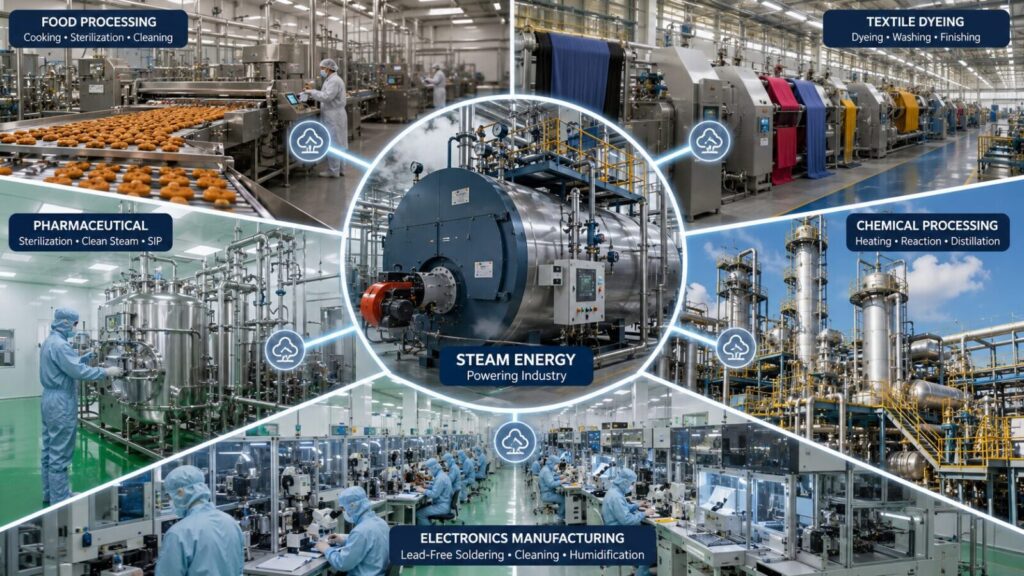
5.3 Applications of Industrial Boilers in Manufacturing Industries
Although production technologies vary by industry, steam remains an important source of thermal energy in many industrial processes. Therefore, industrial boilers are still indispensable equipment in many modern factories.
| Industry | Application |
|---|---|
| Food | Cooking, steaming, sterilization |
| Beverages | Product pasteurization |
| Pharmaceuticals | Clean steam and sterilization |
| Chemicals | Heating reaction tanks |
| Textiles | Dyeing, drying, finishing |
| Industrial laundry | Steam supply for ironing machines |
| Electronics | Production temperature control |
| Hotels | Central hot water systems |
6. Checklist: 7 Criteria for Evaluating a Standard-Compliant Boiler System
Businesses should use this as a basic checklist before investing in or evaluating an existing system. Periodically reviewing these criteria will help significantly reduce the risk of incidents during operation.
6.1 Complete technical documentation
Technical documentation includes drawings, specifications, and factory certificates. A system with clear documentation will be more convenient for maintenance, inspection, and component replacement when needed.
6.2 Compliance with TCVN and international standards
The origin and applicable standards can be verified. This is especially important for exporters or businesses participating in global supply chains.
6.3 Complete safety valve system
The system must be able to automatically release pressure when the threshold is exceeded. Safety valves are the last line of protection for a pressure system. Therefore, they need to be inspected and calibrated periodically.
6.4 Feedwater quality control
This helps reduce scaling and corrosion. It is a factor that directly affects the efficiency and lifespan of the entire steam system.
6.5 Periodic maintenance plan
Proactive maintenance is always much less costly than repairs after an incident has occurred.
6.6 Inspection in accordance with regulations
Inspection helps confirm the safety condition of the equipment and ensures compliance with current legal requirements.
6.7 Trained operators
This helps minimize mistakes during use. Even the most modern system requires operators with appropriate expertise to maximize its effectiveness.
Conclusion
In a modern manufacturing environment, compliance with ISO, JIS, and Vietnamese regulations not only ensures safety but also improves the operating efficiency of industrial boilers.
For businesses in food, beverage, pharmaceutical, chemical, textile, electronics, industrial laundry, and hotel sectors, selecting a standard-compliant industrial boiler system is the foundation for building stable and sustainable production operations while meeting the requirements of both domestic and international customers.
If your business is looking for an industrial boiler or industrial electric boiler solution that meets current production requirements and safety standards, please contact Maruse Engineering for detailed consultation and to select the most suitable system for your factory.