In recent years, the demand for industrial boilers has been increasing significantly, especially in industrial laundry, hotels, commercial centers, and large-scale fabric processing service facilities. Steam plays a crucial role in processing, softening, drying, sterilizing, and finishing fabric surfaces. Therefore, choosing the right industrial electric boiler not only affects operational quality but also determines the ability to save costs and enhance business competitiveness.
This article will help you understand the role of electric boilers in the laundry industry, their operating mechanisms, the advantages compared to traditional boilers, as well as applications in various other industries such as food, textiles, chemicals, hotels, and healthcare.
1. Overview of electric boilers in the laundry industry
1.1. Why does the laundry industry need steam?
In an industrial laundry production line, steam plays the role of:
- Softening fabric fibers to make them easier to process.
- Supporting fast drying and reducing operating time.
- Creating smooth fabric surfaces during ironing to enhance aesthetics.
- Sterilizing clothes in hotels, hospitals, spas, and healthcare centers.
These factors make steam an indispensable component in industrial laundry facilities, especially in urban areas where a large amount of fabric must be processed in a short period of time.
1.2. Industrial electric boilers – a trend replacing traditional fuels
In the past, businesses often used industrial boilers powered by oil or coal. Today, the trend toward adopting industrial electric boilers is growing rapidly due to:
- Strict emission control and environmental protection policies.
- Higher fire safety requirements.
- Lower maintenance costs compared to boilers using fossil fuels.
- The need for automated operation with reduced dependency on skilled labor.
2. Advantages of electric boilers in industrial laundry
2.1. Clean operation – zero emissions
Unlike boilers burning oil or coal, industrial electric boilers run entirely on electricity, generating no smoke, CO₂, SOx, or NOx. This allows businesses to:
- Easily comply with environmental standards.
- Operate in enclosed spaces without exhaust treatment systems.
- Apply the system inside buildings, hotels, and hospitals.
2.2. Long-term operating cost savings
Although the initial investment for an electric boiler may be higher, businesses save on multiple aspects:
| Category | Electric boiler | Fossil-fuel boiler |
| Maintenance costs | Low | High |
| Operational labor | Minimal | Multiple operators |
| Explosion risk | Almost none | High |
| Emission treatment costs | None | Required |
2.3. Easy installation – easy maintenance
- No fuel storage needed.
- No chimney or combustion chamber required.
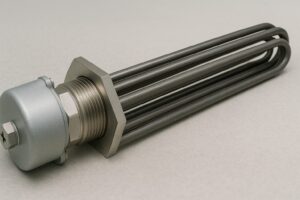
- Maintenance mainly focuses on heating elements and water supply systems.
This is particularly suitable for urban laundry models where floor space is limited.
3. Applications of electric boilers in industries
3.1. Industrial laundry sector
Boilers provide steam for:
- Large-capacity washing machines
- Dryers
- Steam irons and pressing machines
- Fabric sterilization chambers
3.2. Food & beverage industry
Steam is used for:
- Sterilizing bottles and containers
- Steaming food products
- Heating packaging lines
3.3. Textile industry
- Fabric shaping treatment
- Surface finishing and pressing
- Softening fibers before weaving
3.4. Chemical – pharmaceutical industries
- Heating solvents
- Sterilization and disinfection
- Applications in labs and GMP production lines
3.5. Hotel – hospital sector
- Providing steam for in-house laundry systems
- Ensuring hygiene according to international standards
4. Criteria for selecting the right electric boiler for businesses
4.1. Determine steam capacity based on operational needs
Businesses must select boilers based on the amount of laundry processed daily, the number of washing and drying machines, and the operating duration. Accurate steam capacity calculation ensures stable operation without steam shortage during peak hours and avoids energy waste.
4.2. Check electrical systems and water quality
Businesses must ensure that their electrical system can handle the power consumption of industrial electric boilers to avoid overload. In addition, the water supply must be properly treated to prevent scaling and prolong the lifespan of heating elements and boiler components.
4.3. Prioritize boilers with automated control systems
Electric boilers equipped with PLCs, pressure and temperature sensors, and automatic alarm systems enable safe and simple operation, reducing dependence on skilled manpower. This is an essential criterion for laundries looking to optimize processes and reduce labor costs.
4.4. Consider initial investment and operating costs
Businesses should balance initial investment with long-term operating costs. Although electric boilers may cost more upfront than some traditional industrial boilers, their low maintenance, safe operation, and zero emission treatment costs provide long-term savings.
5. Why Maruse Engineering is a reliable partner in the boiler industry
5.1. Proven experience in Vietnam
Maruse Engineering has over 18 years of research, installation, and maintenance experience in boiler systems, delivering suitable solutions for factories, hotels, laundries, and various industrial sectors.
5.2. Comprehensive services
- Assessing steam needs
- Recommending suitable boiler models
- Installation and operator training
- Periodic maintenance
5.3. Related articles on the website
You can learn more in the Column section:
- Industrial electric boilers – A green trend for modern businesses
- Should you choose a low-cost industrial boiler?
- 5 common boiler failures and solutions
>> Reference articles: https://www.marusevn-boiler.com/vi/column/
Conclusion
Industrial electric boilers are becoming an inevitable trend in the laundry industry due to their safety, cleanliness, efficiency, and cost savings. Investing in the right boiler not only optimizes operating expenses but also improves service quality and ensures long-term performance for businesses.
👉 Contact Maruse Engineering to receive tailored boiler solutions for your operational model and production needs.