Introduction
As energy prices continue to fluctuate and emission reduction requirements become increasingly stringent, many FDI enterprises in Vietnam are accelerating their operational cost optimization (OPEX) strategies. Among them, the industrial boiler system is one of the first areas prioritized for improvement because it directly affects fuel consumption, production efficiency, and the factory’s long-term operating costs.
Previously, many companies used traditional industrial boiler systems with large capacities to ensure stable production. However, this model often presents several issues such as high fuel consumption, long startup times, and difficulty optimizing actual operating loads.
Therefore, the trend of switching to Once-Through Boiler systems is increasingly being adopted by Japanese factories and FDI enterprises across Southeast Asia. With their compact design, fast startup capability, and flexible operation based on actual load demand, these systems help businesses significantly reduce energy costs while maintaining stable production efficiency.
1. Why Do Boiler System Costs Directly Impact Factory Profitability?
1.1 Boilers Are the “Thermal Heart” of Production Lines
In reality, many companies only realize the importance of an industrial boiler system when steam shortages or unstable steam pressure directly affect production schedules. This shows that an industrial boiler system not only provides heat but also has a major impact on product quality and the continuous operation of the entire factory. Therefore, the industrial boiler system is considered the “thermal heart” of the entire plant.
Steam generated from industrial boilers is used for production line heating, equipment sterilization, product drying, steam cleaning of components, and humidity control in manufacturing areas.
This is especially important for FDI companies in industries such as food & beverage (F&B), electronics, textiles, pharmaceuticals, packaging, and cosmetics that require high production standards and stable steam supply. In addition, stable steam helps reduce product defect rates and maintain consistent quality across production batches. Therefore, investing in the right industrial boiler system from the beginning can help businesses minimize long-term operational risks.
For example, in the electronics industry, stable steam helps control humidity and reduce static electricity in production rooms. In the food industry, steam is used for sterilization, steaming, and CIP cleaning processes.
>>> Related Articles:
Introduction to Industrial Electric Boilers – The Green Trend
Boiler Applications in the Food Industry: Standards & Operational Efficiency
1.2 Operating Costs That Businesses Often Underestimate
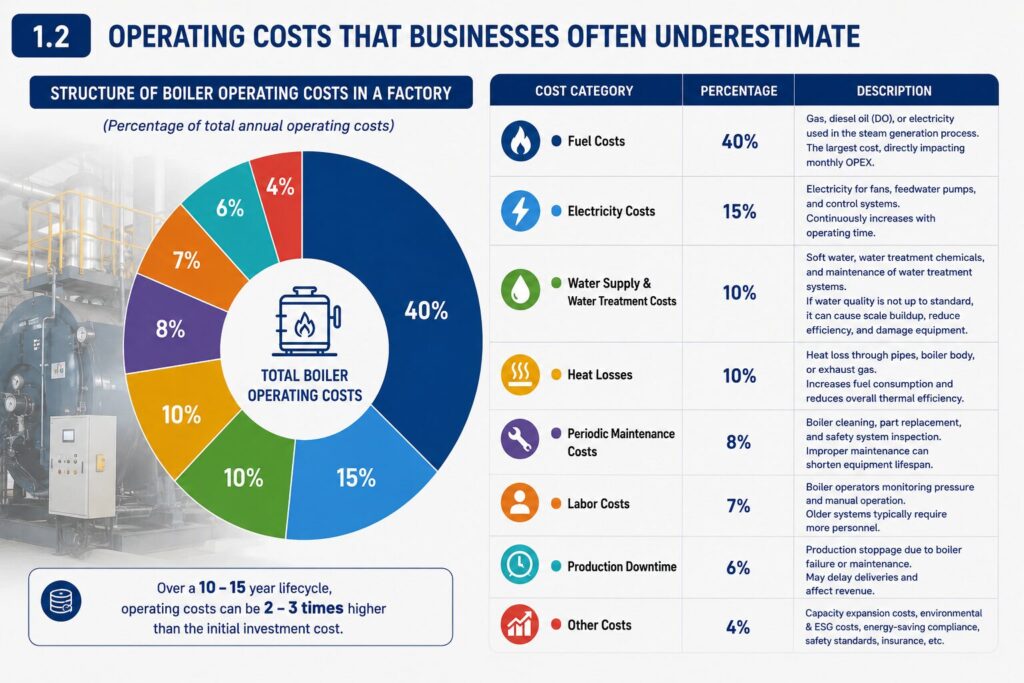
Many businesses focus only on fuel consumption while overlooking the “hidden” costs generated during daily operation. However, when accumulated over the 5–10 year lifecycle of a system, these costs can create a significant difference in the total cost of ownership (TCO).
In addition, if the boiler system operates unstably, businesses may also face indirect costs such as delayed delivery schedules, increased defect rates, or unexpected downtime. This is particularly critical for FDI factories with continuous production processes.
Below are the operating costs throughout the lifecycle of a boiler system:
| Cost Category | Description | Impact on Business |
| Fuel Costs | Gas, DO oil, or electricity used for steam generation | The largest operating expense, directly impacting monthly OPEX |
| Electricity Costs | Electricity for blowers, feedwater pumps, and control systems | Continuously increases according to system operating hours |
| Water Supply & Water Treatment Costs | Soft water, water treatment chemicals, maintenance of water treatment systems | Poor water quality can cause scale buildup, reduced efficiency, and equipment damage |
| Heat Loss | Heat loss through piping, boiler body, or exhaust gas | Increases fuel consumption and reduces overall thermal efficiency |
| Periodic Maintenance Costs | Boiler cleaning, component replacement, safety system inspection | Improper maintenance can shorten equipment lifespan |
| Operation Labor Costs | Boiler operators, pressure monitoring, and manual operation | Older systems typically require more personnel for stable operation |
| Production Downtime | Production stoppage caused by boiler failure or maintenance | May delay deliveries and impact revenue |
| Capacity Expansion Costs | System upgrades when production output increases | Systems lacking flexibility often require large additional investments |
| Environmental & ESG Costs | Emission control and energy-saving standards compliance | Increasingly important for FDI enterprises and export-oriented factories |
1.3 Why Do Older Boiler Systems Often Waste Energy?
In reality, many older boiler systems can still operate normally, but their thermal efficiency has significantly decreased over time. As a result, businesses may not realize how much excess fuel is being consumed daily.
In addition, older-generation industrial boiler systems are often difficult to integrate with modern energy management systems or automated monitoring systems. This limits operational optimization and makes it more difficult for businesses to accurately control energy costs.
2. What Is a Once-Through Boiler? Why Is It Preferred by Many Japanese Factories?
2.1 Concept of Once-Through Boiler
A Once-Through Boiler is a type of industrial boiler with a compact design that operates based on rapid steam generation and one-way water circulation.
Unlike traditional boilers that require storing a large volume of water inside the boiler body, the Once-Through Boiler system only heats the amount of water necessary according to the actual operating load. This helps:
- Increase startup speed
- Reduce heat loss
- Optimize fuel consumption
Another outstanding feature is its modular design. Instead of using one large-capacity boiler, businesses can combine multiple smaller modules to flexibly operate according to production demand.
In Japan, this model has been widely applied in electronics factories, food factories, pharmaceutical plants, and industrial laundry centers.
2.2 Key Advantages of Industrial Boilers for FDI Enterprises
Fuel Savings
This is the most important reason why many businesses are switching to Once-Through Boiler systems.
The system is capable of:
- Fast startup within just a few minutes
- Automatically adjusting according to actual load demand
- Reducing steam waiting time
As a result, businesses can significantly reduce gas or oil consumption compared to traditional boilers.
As energy prices continue to rise, fuel-saving capability helps businesses improve long-term profitability and reduce production cost pressure.
In addition, operating based on actual load demand helps minimize “excess capacity burning,” which is a common cause of energy waste in many traditional boilers.
Space-Saving Installation
Production space is becoming increasingly important, especially in industrial zones where land rental costs are high.
For long-operating factories, technical space is often limited and difficult to expand for additional equipment installation. Therefore, compact boiler systems become an ideal solution for upgrading systems without significantly affecting the existing factory layout.
This boiler model is suitable for factories upgrading old systems, factories expanding production lines, and factories with limited technical space.
Reduced Operation Manpower
Many modern boiler systems are integrated with automatic control, remote monitoring, and intelligent fault warning systems.
As a result, businesses reduce dependence on operator skill levels and minimize operational errors during use.
In addition, early fault warning systems help reduce unexpected downtime and support more effective preventive maintenance.
This is a major advantage as many businesses currently face shortages of experienced technical personnel specializing in industrial thermal equipment.
Stable Steam for High-Quality Production
In many precision manufacturing industries, even small fluctuations in temperature or steam pressure can affect final product quality. Therefore, steam stability is always a critical concern for FDI enterprises.
A stable steam system also helps businesses reduce material waste and improve consistency between production batches, thereby enhancing credibility with international customers.
Specifically, Once-Through Boiler systems help maintain stable pressure, reduce temperature fluctuations, and minimize product defects.
>>> Related Articles:
Industrial Boilers in Electronics Manufacturing: Humidity Control & Component Cleaning
Introduction to Industrial Electric Boilers – The Green Trend
What Is a Once-Through Boiler? The Trend of Modern Industrial Boilers
2.3 Why Do Japanese Companies Prefer Modular Boiler Systems?
Japanese companies often prioritize systems with flexible operation capabilities and minimal production stoppage risk. Therefore, modular boiler systems are highly valued for their ability to distribute loads efficiently across multiple modules.
Modular boiler systems effectively meet these requirements.
- Easy capacity expansion: When production output increases, businesses only need to add new modules instead of replacing the entire system.
- Flexible according to production demand: The system can automatically turn modules on/off based on actual steam demand.
- If one unit is under maintenance → the system still operates: This is a very important advantage that helps reduce production line stoppage risk.
- Reduced operational risk: If using one large-capacity boiler, the entire production line may stop when a failure occurs.
Meanwhile, modular systems help businesses maintain stable production even when one module requires periodic maintenance.
3. What Should FDI Enterprises Consider When Investing in Industrial Boilers?
3.1 Do Not Focus Only on Initial Investment Costs
Many businesses choose boilers based on low purchase prices. However, this is often the reason operating costs become significantly higher over the following years.
Instead of focusing only on CAPEX, businesses should evaluate:
- Total Cost of Ownership (TCO)
- Fuel costs over 5–10 years
- Maintenance costs
- Actual operational efficiency
In many cases, a high-efficiency boiler system can help businesses save billions of VND in energy costs every year.
3.2 Factors to Check Before Selecting a Boiler
Actual steam demand: Businesses need to accurately calculate steam flow requirements for each production line.
Peak load: Many factories experience sudden load increases. If the selected capacity is unsuitable, the system may face steam shortages.
Fuel type:Depending on factory infrastructure, businesses may choose Gas / Oil / Electricity.
Installation space: Some traditional boiler systems require large spaces for boiler rooms / water tanks / piping systems.
Automation requirements: Modern factories often prioritize systems with centralized control, online monitoring, and IoT integration.
>>> Related Article: How to Properly Maintain Industrial Boilers
3.3 The Role of Technical Consulting Units
An efficient boiler system depends not only on the equipment itself but also heavily on the initial survey and design process.
Technical consulting units should:
- Survey actual operating loads
- Evaluate steam demand for each process stage
- Calculate energy efficiency
- Recommend suitable boiler capacity
This helps businesses:
- Avoid overcapacity investment
- Optimize fuel consumption
- Reduce operational risks
- Extend equipment lifespan
For FDI enterprises, selecting a consulting unit with real experience working with Japanese factories is a very important factor in ensuring long-term investment efficiency.
4. Conclusion
Today, industrial boilers are not only steam-generating equipment but also directly impact operating costs, production efficiency, and corporate energy-saving goals.
With fuel-saving capabilities, flexible operation, and high automation, Once-Through Boilers are becoming a preferred trend among many FDI factories in Vietnam to optimize long-term costs and improve operational efficiency.
👉 Learn more about Once-Through Boiler solutions for FDI factories with Maruse Engineering Vietnam
👉 Contact Maruse for consultation on industrial boiler solutions suitable for your production line
👉 Download the CZI Boiler catalog to view technical specifications and real application models