

In modern factories, steam plays an important role in heating, sterilization, drying, and operating production lines. However, to ensure the steam system operates stably and efficiently, businesses not only need to invest in industrial boilers but also optimize the entire steam distribution system.
One of the small devices that directly affects operational efficiency is the steam trap. This component helps remove condensate, reduce steam loss, and protect the piping system during continuous operation.
As energy costs continue to rise, many businesses are paying greater attention to optimizing the performance of the entire boiler system rather than focusing only on boiler capacity. This is especially important for continuously operating industries such as food processing, pharmaceuticals, laundry services, and chemicals, where steam directly impacts product quality and operating costs.
Although steam traps are relatively small components within the system, they play an important role in maintaining heat transfer efficiency and reducing energy loss. When properly selected and maintained, steam traps can help businesses significantly reduce fuel costs and extend equipment lifespan.
In this article, let’s explore what a steam trap is, how it works, and its important role in industrial boiler systems.
1. What is a Steam Trap?
1.1 What is a Steam Trap?
A steam trap is an automatic device installed in a boiler system to separate and discharge condensate from piping systems while retaining high-pressure and high-temperature steam.
In practice, as steam moves through piping systems or heat exchange equipment, it gradually loses heat and turns into condensate. If this condensate is not removed promptly, heat transfer efficiency can decrease significantly.
Therefore, steam traps are considered essential equipment in:
- industrial boilers
- industrial electric boilers
- heating systems
- heat exchange equipment
- industrial drying systems
In addition to condensate discharge, steam traps also help:
- Reduce live steam loss
- Discharge non-condensable gases
- Maintain stable thermal efficiency
- Protect industrial thermal equipment
Many businesses often focus only on the efficiency of industrial boilers while overlooking auxiliary equipment such as steam traps. In reality, however, these components directly affect energy-saving capability and the stability of the entire steam system.
Steam traps operate almost continuously throughout factory operations. Therefore, if the device malfunctions or is selected improperly, steam loss can increase rapidly over time.
1.2 Why Does a Steam System Always Generate Condensate?
In any industrial boiler system, steam generated by the boiler transfers heat to production equipment through piping systems and heat exchangers.
During this process:
- Part of the heat energy is lost to the environment
- Steam gradually cools down
- Steam turns into condensate
This is a completely natural phenomenon in all boiler systems.
If excessive condensate accumulates, it can cause:
- Reduced heat transfer efficiency
- Slower heating equipment performance
- Increased fuel consumption
- Occurrence of Water Hammer phenomenon
- Corrosion of pipes and valves
Especially in continuously operating food processing, pharmaceutical, or industrial laundry factories, efficient condensate management can help businesses significantly reduce operating costs.
Even when piping systems are properly insulated, heat loss still occurs during steam transportation. The longer the piping distance or the colder the operating environment, the greater the amount of condensate generated.
This is also why many modern factories are increasingly focusing on optimizing condensate recovery systems and conducting regular steam trap inspections to reduce long-term operating costs.
>>> Related Articles:
What is an Industrial Boiler? Mechanism & Applications
How to Calculate Steam Demand Based on Factory Scale
1.3 Operating Principle of a Steam Trap
The operating principle of a steam trap is:
- Allow condensate to pass through
- Retain hot steam
Steam traps automatically open or close based on:
- Temperature
- Pressure
- Density difference between steam and water
Basic operating cycle:
- Hot steam enters the system
- Steam transfers heat to equipment
- Steam condenses into water
- The steam trap discharges condensate
- The valve closes to prevent live steam loss
This mechanism allows the steam system to operate continuously without manual intervention.
Each type of steam trap has a different opening and closing mechanism depending on its mechanical or thermodynamic design. However, the common objective is to ensure condensate is removed quickly without losing valuable high-temperature steam.
Thanks to automatic operation, steam traps help businesses significantly reduce manual inspection workloads and maintain steam system stability during continuous production operations.
2. The Role of Steam Traps in Industrial Boiler Systems
2.1 Improving Heat Transfer Efficiency
One of the most important roles of a steam trap is to maintain stable heat transfer efficiency.
When condensate is removed quickly:
- Heat exchange equipment remains in direct contact with hot steam
- The heating process becomes faster
- Production lines operate more stably
In industries such as food, beverages, pharmaceuticals, and chemicals, stable temperature is a factor that directly affects final product quality.
When heat exchange surfaces are covered by condensate, heat transfer capability decreases significantly compared to direct contact with hot steam. This prolongs heating time and increases the system’s energy consumption.
For production lines that require precise temperature control, such as food processing or pharmaceuticals, maintaining stable heat transfer efficiency also helps ensure more consistent product quality.
2.2 Reducing Steam Loss and Saving Energy
Many businesses focus only on the efficiency of industrial boilers without paying enough attention to losses in steam piping systems.
In reality, a malfunctioning steam trap can cause a large amount of live steam to be lost every day.
This leads to:
- Increased fuel consumption
- Higher electricity consumption during operation
- The boiler having to operate more frequently
- Continuously increasing operating costs
For industrial electric boilers, optimizing steam traps is especially important because electricity costs often account for a large share of operating expenses.
Today, the trend of energy-saving factories in Japan and Vietnam focuses on:
- Condensate recovery
- Reducing heat loss
- Regular inspection of steam trap systems
In many cases, businesses may not realize that a steam trap is leaking because the system still appears to operate normally. However, continuous live steam loss can significantly increase fuel costs month after month.
This is also why Japanese factories often establish regular steam trap inspection plans as part of their energy-saving and boiler operation optimization strategy.
2.3 Protecting Piping Systems and Equipment
When condensate remains inside the piping system, the Water Hammer phenomenon can occur.
This is a phenomenon in which steam pushes condensate at high speed, creating strong impact forces inside the piping system.
The consequences include pipe cracking, valve damage, system leakage, and reduced lifespan of industrial thermal equipment.
Installing steam traps in the correct positions helps:
- The system operate more smoothly
- Reduce vibration
- Extend the lifespan of the entire boiler system
The Water Hammer phenomenon not only causes loud noise but also poses safety risks inside the factory. If it occurs repeatedly, pipes and valves can be seriously damaged, directly affecting production operations.
Installing steam traps in the correct locations helps steam flow more stably and limits condensate accumulation in the piping system.
2.4 Supporting Condensate Recovery
Recovered condensate still contains a high amount of heat energy.
Businesses can reuse feedwater, reduce the initial heating energy required, and lower overall water consumption.
This solution is widely applied by many factories to:
- Reduce operating costs
- Reduce CO₂ emissions
- Move toward sustainable manufacturing
In many modern systems, recovered condensate can reach a relatively high temperature and still has significant reusable value. Therefore, reusing this water source helps substantially reduce the energy required to heat new feedwater.
In addition to cost savings, this is also a solution that supports businesses in moving toward green manufacturing models and reducing carbon emissions over the long term.
>>> Related Article: Comparison of Electric Boilers, Oil-Fired Boilers, and Gas-Fired Boilers
3. Common Types of Steam Traps Today
In industrial boiler systems, each type of steam trap is suitable for different operating conditions and purposes. Choosing the right steam trap not only helps the system operate stably but also directly affects heat transfer efficiency and long-term energy costs.
Today, businesses often select steam traps based on:
- Operating pressure
- Condensate flow rate
- Thermal stability
- Production environment
- Maintenance cost
Below are the types of steam traps commonly used in modern boiler systems.
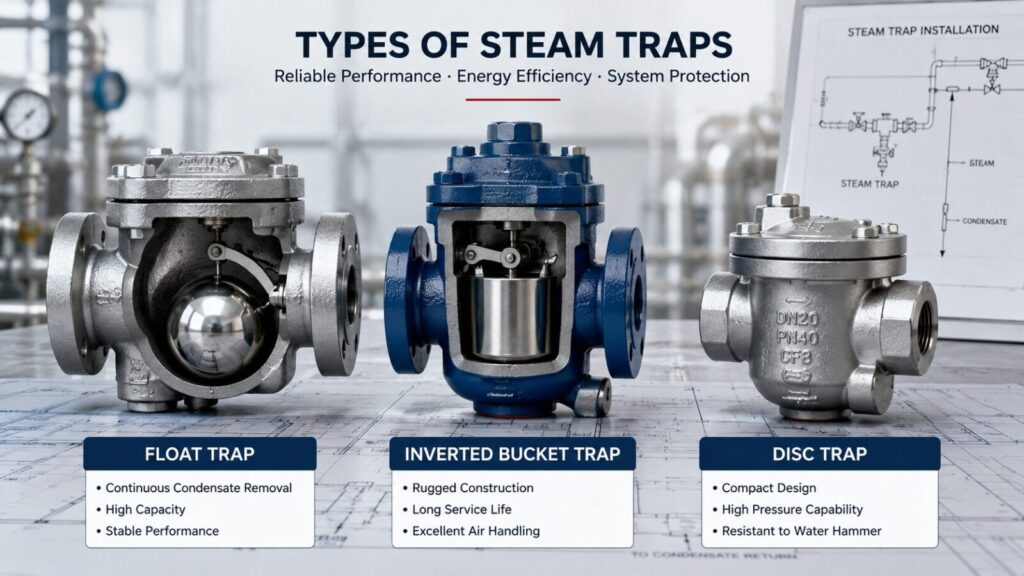
3.1 Mechanical Steam Traps
Mechanical steam traps operate based on the difference in density between steam and condensate. When condensate accumulates inside the device, the float or internal mechanical mechanism automatically opens the valve to discharge the water.
Common types include:
- Float Trap
- Inverted Bucket Trap
Advantages of mechanical steam traps:
- Continuous condensate discharge
- Stable heat transfer capability
- Suitable for high-load systems
- High operating efficiency
This type of steam trap is commonly used in:
- Food processing factories
- Continuous heating lines
- Large heat exchange systems
- Beverage factories
Thanks to continuous condensate discharge, mechanical steam traps help limit condensate accumulation inside equipment. This is especially important for industries that need to maintain stable temperatures to ensure final product quality.
However, businesses should also pay attention to regular maintenance to prevent wear of mechanical components after long periods of continuous use.
3.2 Thermodynamic Steam Traps
Thermodynamic steam traps operate based on the difference in pressure and velocity between steam and condensate. When hot steam passes through at high speed, the valve automatically closes to retain steam within the system.
The most common type today is the Disc Trap.
Advantages:
- Compact design
- High pressure resistance
- Good durability
- Easy installation
- Low maintenance cost
Thanks to its simple structure, this type of steam trap is commonly used in:
- Steam piping systems
- Outdoor areas
- Factories with limited installation space
- High-pressure steam line systems
In addition, thermodynamic steam traps can operate effectively in high-temperature environments and harsh operating conditions. This is why many factories choose this type of equipment for the main pipelines of their boiler systems.
However, if the condensate load changes continuously, operating efficiency may be less stable than that of mechanical steam traps.
3.3 Thermostatic Steam Traps
Thermostatic steam traps operate based on changes in the temperature of the medium. When the temperature drops due to the presence of condensate, the valve automatically opens to discharge the water.
Advantages:
- Good temperature control
- Stable operation
- Reduced steam loss
- Suitable for systems requiring high precision
This type of steam trap is commonly used in:
- Pharmaceutical industry
- Clean steam systems
- Clean food processing factories
- Sterilization equipment
In industries with strict steam quality requirements, maintaining stable temperature is extremely important. Therefore, thermostatic steam traps help limit temperature fluctuations and improve production process stability.
In addition, good steam control capability also helps businesses reduce energy loss during long-term operation.
3.4 How to Choose a Suitable Steam Trap
Choosing a steam trap should not be based only on initial cost. Businesses need to evaluate overall operating efficiency and long-term usage costs.
Key factors to consider include:
- Steam pressure
- Operating temperature
- Condensate flow rate
- Purpose of use
- Environmental conditions
- Type of heat exchange equipment
For example:
- Food factories → prioritize stable heat transfer capability
- Pharmaceuticals → require clean steam and high precision
- Laundry services → require large condensate flow capacity
- Chemicals → require high durability and good corrosion resistance
In addition, businesses should also evaluate:
- Energy-saving capability
- Maintenance frequency
- Equipment durability
- Spare part replacement availability
A suitable steam trap not only helps reduce steam loss but also supports the optimization of the entire industrial thermal equipment system in the factory.
>>> Related Article: How to Determine Boiler Capacity for Businesses
4. Signs of Steam Trap Failure and How to Inspect It
A steam trap is a device that operates almost continuously in a steam system. Therefore, after a long period of operation, the device may experience failures that cause energy loss or reduce the efficiency of the entire boiler system.
In many cases, a failed steam trap does not immediately stop the system, making it difficult for businesses to detect the issue with the naked eye. However, without regular inspection, small failures can lead to higher operating costs over time.
4.1 Common Failures
Some common steam trap failures include:
- Stuck open
- Stuck closed
- Live steam leakage
- Clogging caused by dirt or scale
- Internal valve damage
Common causes include:
- Dirt or scale inside the system
- Equipment corrosion
- Unstable operating pressure
- Incorrect installation
- Lack of regular maintenance
When a steam trap fails, hot steam may continuously leak without being immediately noticed by the business. This significantly increases the fuel consumption of industrial boilers over time.
4.2 Effects of Steam Trap Failure
A failed steam trap can have a major impact on the entire operating system.
Common impacts include:
- Increased fuel consumption
- Reduced heat transfer efficiency
- Unstable heating performance
- Occurrence of Water Hammer phenomenon
- Increased boiler load
- Reduced equipment lifespan
Especially in industries that require precise temperature control, such as food processing or pharmaceuticals, unstable temperature can directly affect final product quality.
In addition, the boiler has to operate at a higher load to compensate for the lost steam. This causes the entire boiler system to consume more energy and increases operating pressure over the long term.
4.3 Steam Trap Inspection Methods
Today, many businesses conduct regular steam trap inspections to optimize energy efficiency.
Common inspection methods include:
- Surface temperature inspection
- Sound inspection
- Ultrasonic inspection
- Pressure and flow monitoring
- Monitoring system supervision
Among these methods, ultrasonic inspection equipment is widely used because it can detect steam leakage quickly and accurately without requiring system disassembly.
In addition, establishing a regular inspection schedule helps businesses proactively detect potential risks before major failures occur.
4.4 Importance of Regular Maintenance
Steam trap maintenance is not only a technical activity but also an effective energy management solution for businesses.
When steam traps are inspected regularly:
- The steam system operates more stably
- Heat loss is reduced
- Downtime is minimized
- Equipment lifespan is extended
- Long-term operating costs are optimized
Many Japanese factories today consider steam trap inspection an important part of their energy-saving and CO₂ emission reduction strategy.
Especially for businesses using industrial electric boilers or large-load steam systems, maintaining stable steam trap operation can significantly optimize production efficiency.
5. Practical Applications of Steam Traps in Industrial Sectors
Steam traps are now widely used in many manufacturing sectors thanks to their ability to optimize thermal efficiency and reduce energy loss. Depending on the industry, temperature and steam quality requirements may vary.
Therefore, choosing the right type of steam trap helps businesses significantly improve the operating efficiency of the entire steam system.
5.1 Food and Beverage Industry
In the food industry, steam is commonly used for:
- Sterilization
- Pasteurization
- Tank heating
- CIP systems
Steam traps help:
- Maintain stable temperature
- Improve heat transfer efficiency
- Reduce condensate accumulation
- Limit contamination risks
Stable temperature directly affects food product quality and safety. Therefore, steam traps play an important role in maintaining stability throughout the entire production line.
5.2 Pharmaceutical Industry
The pharmaceutical industry requires very strict steam quality to ensure production standards.
Steam traps help:
- Remove condensate effectively
- Maintain clean steam quality
- Reduce temperature fluctuations
- Support production process control
Good condensate control also helps reduce the risk of affecting finished product quality or sterilization systems in pharmaceutical factories.
5.3 Garment and Laundry Industry
In the garment and laundry industry, steam is commonly used for:
- Heat press machines
- Drying systems
- Industrial ironing machines
Steam traps help maintain stable thermal efficiency and reduce fuel consumption during continuous operation.
At the same time, a stable steam system also helps extend the lifespan of heat-using equipment in the factory.
5.4 Hotels and Hospitals
In hotels and hospitals, steam is used for:
- Central hot water systems
- Industrial laundry systems
- Sterilization equipment
Steam traps help the system operate more stably and reduce heat loss during daily operation.
In addition to energy savings, condensate control also helps improve safety and durability for the building’s technical system.
5.5 Chemical Industry
Chemical factories often require:
- Continuous heating
- Stable thermal reaction control
- Systems that can withstand high temperatures
Steam traps help maintain steam quality and prevent condensate accumulation inside piping systems.
In addition, reducing the Water Hammer phenomenon also helps protect equipment in high-pressure and high-temperature operating environments.
6. Conclusion
Steam traps are important devices that help the boiler system operate stably, reduce steam loss, and optimize heat transfer efficiency. Although small in size, steam traps directly affect energy costs and the durability of the entire boiler system.
Choosing the right type of steam trap and maintaining it regularly will help businesses:
- Save fuel
- Reduce operating costs
- Protect industrial thermal equipment
- Improve production stability
We hope this article provides useful information to help businesses better understand the role of steam traps in industrial boilers and optimize the operating efficiency of steam systems in factories.
Contact Maruse Engineering Vietnam for consultation on industrial boiler solutions, steam systems, and steam traps suitable for your business’s specific production needs.