For many years, Japanese boilers have been recognized as one of the most reliable and durable steam generation solutions available on the market. In addition to their advanced technology and energy-saving performance, Japanese industrial boiler systems are built upon a solid foundation of JIS (Japanese Industrial Standards).
For manufacturers operating in industries such as food and beverage, pharmaceuticals, textiles, chemicals, and electronics, selecting an industrial electric boiler or an industrial steam boiler that complies with JIS standards is more than just meeting technical specifications. It is also a key factor in minimizing operational risks, reducing maintenance costs, and extending the service life of equipment over many years of operation.
In fact, many FDI manufacturing plants in Vietnam—particularly those owned by Japanese, Korean, and European companies—are placing greater emphasis on ensuring that thermal equipment complies with international standards from the design and installation stages. Among these, JIS is regarded as one of the most comprehensive and practical standards for industrial thermal equipment.
This article will help businesses gain a clear understanding of what JIS standards are, which JIS standards are commonly applied in Japanese boiler systems, and how these standards contribute to improved efficiency, operational safety, and lower operating costs for manufacturing facilities.
1. What Are JIS Standards? Why Are They Considered the Benchmark for Japanese Boiler Systems?
1.1. What Are JIS Standards?
JIS (Japanese Industrial Standards) is Japan’s national industrial standards system, established to standardize technical requirements for products, materials, manufacturing processes, and testing methods across a wide range of industries.
These standards are established under the Industrial Standardization Act and are administered by Japan’s Ministry of Economy, Trade and Industry (METI). The technical content is developed through collaboration among industry associations, research institutes, and leading manufacturers before being published by the Japanese Standards Association (JSA).
Unlike the common misconception that JIS is merely a “quality certification,” it is, in fact, a comprehensive technical standards system that defines requirements covering material selection, structural design, manufacturing methods, quality inspection, as well as equipment operation and maintenance.
For the boiler industry, JIS serves as a “guideline” that helps manufacturers ensure that every piece of equipment placed into service meets requirements for:
- Mechanical strength of the boiler body.
- The ability to withstand high pressure and temperature over extended periods.
- Stable steam generation efficiency.
- Steam quality for production processes.
- Safety for operators and the entire production line.
As a result, industrial boiler systems manufactured in accordance with JIS standards generally offer a longer service life, a lower failure rate, and more optimized maintenance costs than equipment that is not designed according to equivalent standards.
Reference information: According to the Japanese Standards Association (JSA), JIS is Japan’s national standards system applied across numerous industrial fields, including pressure equipment, mechanical engineering, materials, electrical and electronic equipment, and energy systems such as boilers and steam systems.
1.2. Why Are JIS Standards Trusted by Many FDI Companies?
In industrial parks across Vietnam, it is common to see Japanese factories continue to prioritize Japanese boilers even when the initial investment cost may be higher than that of some other equipment options.
The reason is that companies do not evaluate only the purchase price of the equipment. They also consider the Total Cost of Ownership (TCO) throughout the system’s entire life cycle.
An industrial boiler operating continuously for thousands of hours each year consumes substantial amounts of fuel, electricity, and feed water. Even a small reduction of a few percentage points in heat transfer efficiency due to scale buildup or an inadequately optimized design can cause a company to spend hundreds of millions of Vietnamese dong more each year on fuel and maintenance.
JIS standards are developed to minimize these risks from the design stage.
Some of the key benefits include:
Ensuring the safety of pressure equipment
Boilers operate under high-pressure and high-temperature conditions. If the boiler body structure, welds, or protection systems fail to meet the required standards, the risk of an incident increases significantly.
JIS standards establish strict requirements for:
- Pressure-retaining design.
- Material selection.
- Non-destructive testing (NDT).
- Pressure testing before commissioning.
- Safety valves and protective devices.
As a result, the equipment can operate reliably for an extended period while maintaining a high level of safety.
Maintaining stable steam generation efficiency
The efficiency of industrial thermal equipment depends not only on the burner or fuel source, but also on heat transfer design, feed water quality, and the ability to control scale buildup.
A system developed in accordance with JIS standards takes the entire steam generation cycle into account, from water supply and heat transfer to the quality of the steam delivered.
This is particularly important for industries such as:
- Food processing.
- Beverage production.
- Pharmaceuticals.
- Electronics.
- Semiconductors.
These industries all require a stable steam supply to maintain consistent product quality.
Reducing long-term maintenance costs
For businesses, operating costs are often considerably higher than the initial investment cost.
An industrial electric boiler or fuel-fired boiler designed according to appropriate standards can:
- Reduce the rate of corrosion.
- Limit scale buildup.
- Reduce localized overheating.
- Extend the service life of steam-generating tubes.
- Reduce production downtime for repairs.
This is why Japanese companies regard compliance with technical standards as a long-term investment that can generate cost savings for many years.
Improving compatibility across the entire production line
One of the key advantages of JIS standards is the compatibility and standardization they create among different types of equipment.
In addition to industrial boilers, many other components, including:
- Piping.
- Industrial valves.
- Pressure measuring instruments.
- Temperature measuring instruments.
- Feed water pumps.
- Heat exchangers.
…are also designed according to unified technical standards.
This makes system installation, component replacement, maintenance, and upgrades more convenient throughout the project life cycle.
1.3. How Do JIS Standards Differ from ISO and TCVN?
Many businesses often confuse JIS, ISO, and TCVN. In practice, these are three standards systems with different scopes and objectives.
| Criteria | JIS | ISO | TCVN |
| Issuing authority | Japan | International Organization for Standardization | Vietnam |
| Scope of application | National standards, widely applied globally by Japanese companies | International | Vietnam |
| Level of detail | Highly detailed, with a strong focus on technical and manufacturing requirements | Primarily establishes principles and management systems | Adapted to domestic legal and technical conditions |
| Applicable subjects | Equipment, materials, and manufacturing processes | Management systems and international standards | Equipment and technical regulations in Vietnam |
| Application to boilers | Design, materials, feed water, and quality inspection | ISO 45001, ISO 9001, ISO 14001, etc. | Inspection, safety, and operation in accordance with legal regulations |
In simple terms:
- ISO helps businesses establish quality and safety management systems.
- TCVN serves as the basis for businesses to comply with technical and legal requirements in Vietnam.
- JIS focuses in detail on the technical requirements of individual equipment, helping ensure quality and performance from the design and manufacturing stages through inspection.
For Japanese-invested companies or businesses targeting export markets, selecting Japanese boilers that comply with JIS standards can provide an advantage during factory assessments, technical audits, and evaluations conducted by international customers.
2. The Most Important JIS Standards for Japanese Boiler Systems
As mentioned above, JIS is not a single standard. It is a system consisting of thousands of standards applied across numerous industrial fields. For industrial boilers, JIS provides detailed requirements covering design, materials, manufacturing, quality inspection, feed water quality, and steam quality during operation.
A clear understanding of these standards helps businesses accurately evaluate the quality of a Japanese boiler and avoid relying solely on the equipment’s country of origin or brand while overlooking important technical factors.
The following are some of the most commonly applied JIS standards in the industrial thermal equipment sector.
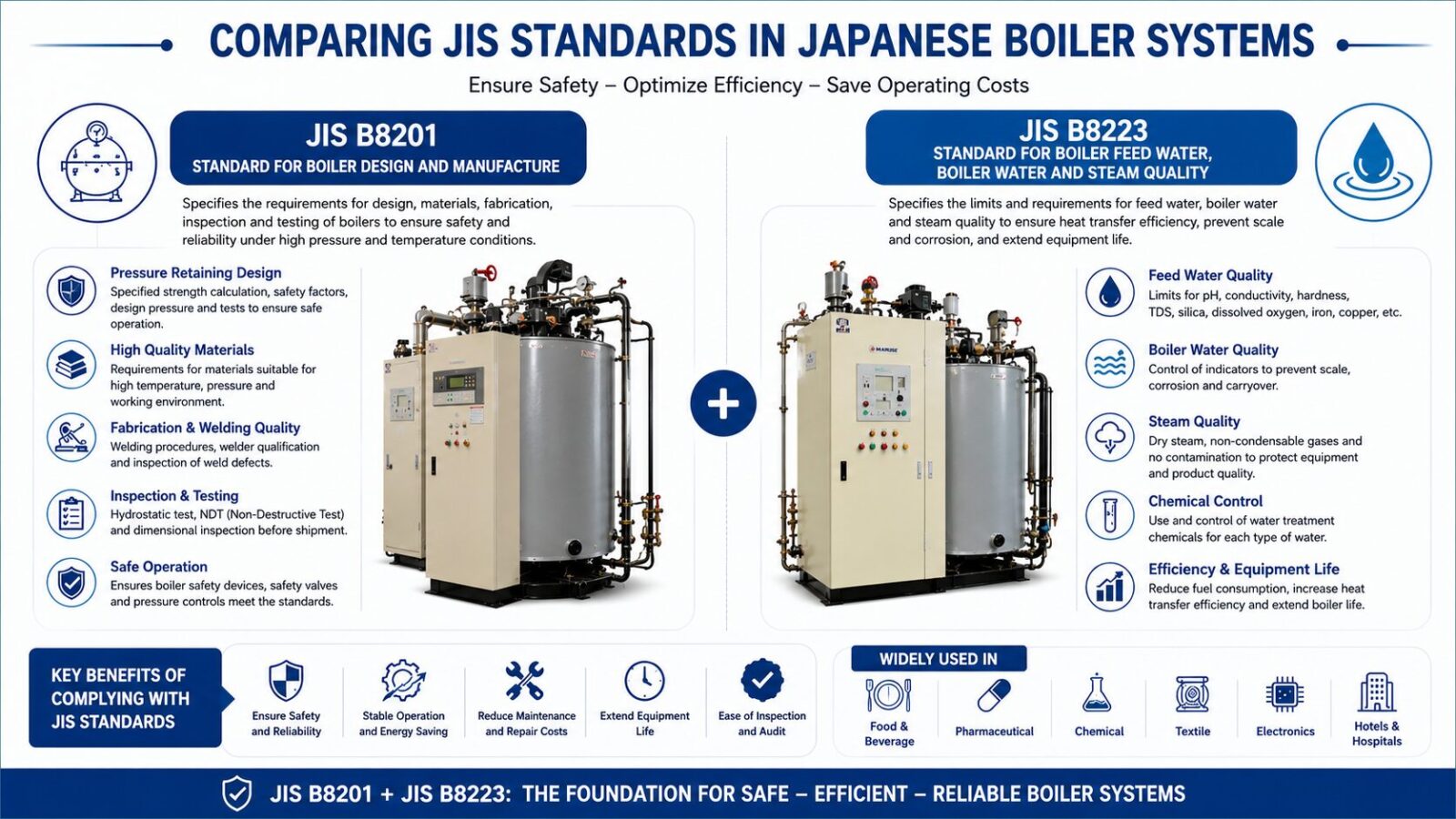
2.1. JIS B 8201 – Standard for Boiler Structure and Design
Among the standards related to Japanese boilers, JIS B 8201 is regarded as one of the most important foundations. This standard specifies technical requirements for boiler design and manufacture to ensure that equipment can operate reliably under high-pressure and high-temperature conditions.
In addition to regulating equipment dimensions and configuration, JIS B 8201 also controls many factors that directly affect boiler safety and service life.
The main requirements include:
- Design of the boiler body and combustion chamber.
- Design pressure calculations.
- Selection of heat-resistant and pressure-resistant materials.
- Welding procedures and weld inspection.
- Deformation inspection before shipment.
- Leak testing and pressure testing (Hydrostatic Test).
- Strength inspection of pressure-retaining components.
These requirements help minimize risks such as:
- Cracking of the boiler body.
- Thermal deformation.
- Steam leakage.
- Pressure loss.
- Damage to steam-generating tubes.
For factories operating continuously around the clock, particularly those in the food or chemical industries, maintaining stable equipment operation over extended periods is essential for both production efficiency and safety.
For example, if a boiler in a food processing plant must be shut down because of a structural failure, the entire sterilization, cooking, or pasteurization line may need to stop, directly affecting delivery schedules and product quality.
For this reason, many FDI companies prioritize industrial boilers manufactured in accordance with JIS standards to minimize risks from the outset.
2.2. JIS B 8223 – Standard for Feed Water, Boiler Water, and Steam Quality
While JIS B 8201 focuses on boiler structure, JIS B 8223 is considered the “heart” of the operating process.
In practice, many industrial boiler failures are not caused by design defects but by inadequate control of water quality.
Feed water containing excessive minerals, dissolved oxygen, or impurities can cause various problems, including:
- Scale buildup on heat transfer surfaces.
- Piping corrosion.
- Corrosion of the boiler body.
- Increased fuel consumption.
- Reduced steam quality.
- Shortened equipment service life.
For this reason, JIS B 8223 clearly specifies requirements for:
- Water supplied to the boiler (Feed Water).
- Water inside the boiler (Boiler Water).
- Condensate.
- Output steam quality (Steam Quality).
The standard establishes limits for several important technical parameters, including:
- pH level.
- Electrical conductivity.
- Dissolved oxygen content.
- Water hardness.
- Silica content.
- Total dissolved solids (TDS).
- Iron and copper content.
Maintaining these parameters within the permitted limits helps the steam system operate reliably and significantly reduces maintenance costs.
Under the JIS B 8223:2021 edition, water quality requirements were updated to better reflect modern boiler technologies and high-pressure systems commonly used in Japanese industries.
2.3. Why Does Water Quality Have Such a Significant Impact on Boiler Efficiency?
When investing in an industrial electric boiler, many businesses tend to focus on capacity or fuel type without properly evaluating the role of the water treatment system.
In practice, even a thin layer of scale only a few millimeters thick on the heat transfer surface can significantly reduce the equipment’s heat transfer capability.
As a result, the burner or heating element must operate for a longer period to generate the same amount of steam.
This can lead to several consequences:
- Higher fuel or electricity consumption.
- Longer steam generation time.
- Higher tube wall temperatures.
- Increased thermal stress.
- Shortened equipment service life.
This process can be illustrated as follows:
| Inadequate water quality | → | Scale buildup and corrosion |
| Increased scale buildup | → | Reduced heat transfer |
| Reduced heat transfer | → | Increased energy consumption |
| Increased energy consumption | → | Higher operating costs |
| Increased corrosion | → | More frequent shutdowns for repairs |
This is why Japanese boiler systems are often designed with integrated water treatment systems, water softening equipment, and chemical control programs from the initial design stage.
For businesses that use steam in industries with strict quality requirements, such as food processing or pharmaceuticals, investing in a compliant water treatment system also helps reduce the risk of contamination and maintain consistent product quality.
>>> Related article: How Does ISO 45001 Affect Industrial Boiler Systems?
2.4. Other JIS Standards Commonly Applied to Boiler Systems
In addition to JIS B 8201 and JIS B 8223, a complete industrial thermal equipment system is also subject to various other JIS standards covering materials, piping, welded joints, and auxiliary equipment.
Some commonly applied groups of standards include:
Standards for pressure-retaining materials
Materials used to manufacture boiler bodies, steam-generating tubes, and pressure vessels must meet requirements for:
- Tensile strength.
- High-temperature resistance.
- Corrosion resistance.
- Ductility and machinability.
Selecting the correct materials helps limit cracking caused by thermal fatigue and deformation after extended periods of operation.
Standards for welding and weld inspection
Welded joints are areas subjected to significant stress throughout the boiler system.
Therefore, JIS standards establish strict requirements for:
- Welding procedures.
- Welder qualifications.
- Inspection methods.
- Defect evaluation criteria.
Non-destructive testing (NDT) methods such as ultrasonic testing (UT), radiographic testing (RT), magnetic particle testing (MT), and liquid penetrant testing (PT) are commonly used to detect hidden defects before the equipment is placed into service.
Standards for safety valves and protective devices
An industrial boiler system includes not only the boiler body but also several important protective devices, such as:
- Safety valves.
- Pressure gauges.
- Temperature gauges.
- Water level sensors.
- Pressure warning devices.
- Automatic controllers.
These devices must operate accurately to prevent overpressure, low-water conditions, or overheating, all of which can cause serious incidents if they are not detected in time.
2.5. How Are JIS Standards Applied Across Industries in Vietnam?
Today, FDI companies in Vietnam increasingly prioritize the use of Japanese boilers or systems designed according to JIS standards to meet requirements for quality, safety, and energy efficiency.
Some typical applications include:
| Industry | Boiler Applications |
| Food & Beverage | Steaming, pasteurization, sterilization, cooking, heating, and CIP. |
| Pharmaceuticals | Generating clean steam for production equipment, instrument sterilization, and cleanrooms. |
| Textiles | Heating dyeing machines, dryers, pressing machines, and fabric finishing equipment. |
| Chemicals | Heating reaction vessels, distillation, concentration, and raw material drying. |
| Electronics & Semiconductors | Temperature control in manufacturing processes that require high precision. |
| Industrial Laundry | Supplying steam for high-capacity washing, drying, and pressing systems. |
| Hotels & Hospitals | Supplying steam for central hot-water systems, laundry operations, and disinfection. |
A common requirement across these industries is a stable, continuous, and safe steam supply. Therefore, compliance with JIS standards not only improves the reliability of industrial boilers but also helps maintain product quality and optimize long-term operating costs.
>>> Related article: How to Determine the Appropriate Boiler Capacity for Your Business
3. How Do JIS Standards Help Businesses Reduce Operating Costs?
When selecting an industrial boiler, many businesses focus on the initial purchase price without fully assessing the operating costs incurred throughout the equipment’s life cycle. In practice, the initial investment accounts for only a small portion of the total cost, while fuel, electricity, feed water, water treatment chemicals, maintenance, and production downtime are the key factors that determine the Total Cost of Ownership (TCO).
This is also why Japanese companies tend to prioritize Japanese boiler systems designed according to JIS standards. Rather than merely meeting technical requirements, JIS standards aim to optimize performance and reduce costs throughout the equipment’s entire operating life.
3.1. Reducing Fuel Consumption Through Stable Heat Transfer Efficiency
Fuel expenses typically account for 60–80% of the total operating cost of an industrial boiler system. Therefore, improving heat transfer efficiency by even a few percentage points can help a business achieve significant annual savings.
JIS standards strictly control factors that affect efficiency, including:
- The design of the combustion chamber and heat transfer surfaces.
- The selection of materials with suitable heat transfer properties.
- Feed water quality control to limit scale buildup.
- Ensuring weld quality and system tightness.
- Specified performance testing methods before the equipment is placed into operation.
As a result, the system can maintain stable heat transfer performance and reduce the amount of fuel or electricity required to produce the same quantity of steam.
For an industrial electric boiler, this benefit is reflected in lower electricity consumption per ton of steam. For boilers fueled by oil, gas, or biomass, businesses can reduce fuel input and lower production costs.
For example, a food processing plant operating its boiler continuously for 20 hours per day may save hundreds of millions of Vietnamese dong in annual fuel costs by improving efficiency by only 2–3%, depending on the boiler capacity and fuel type.
3.2. Limiting Scale and Corrosion – Major Causes of Energy Waste
Scale buildup and internal corrosion are among the most common causes of declining efficiency in industrial thermal equipment.
When feed water fails to meet the required standards, minerals such as calcium, magnesium, and silica accumulate on heat transfer surfaces and form an insulating layer. This scale layer makes it more difficult for heat to transfer from the combustion chamber to the water, forcing the system to consume more fuel to maintain the same steam pressure and flow rate.
At the same time, dissolved oxygen and impurities in the water can cause corrosion of:
- Steam-generating tube walls.
- Feed water tanks.
- Condensate return piping.
- Heat exchangers.
- Valves and fittings.
This damage not only increases repair costs but can also interrupt production.
This is why JIS B 8223 establishes strict requirements for feed water and boiler water parameters. When businesses comply with these requirements, the system can:
- Reduce the rate of scale formation.
- Extend the service life of heat transfer surfaces.
- Maintain stable efficiency.
- Reduce the frequency of chemical cleaning.
- Limit the need for component replacement.
These are long-term savings that many businesses may overlook when comparing only the initial purchase prices of industrial boilers.
3.3. Reducing Maintenance Costs and Production Downtime
For continuously operating manufacturing plants, even a single steam system shutdown can affect the entire production line.
For example:
- A food processing plant may have to suspend pasteurization.
- A textile factory may be unable to complete dyeing and drying processes.
- A chemical plant may experience interruptions in reaction vessel heating.
- An electronics factory may be unable to maintain the temperatures required by its production processes.
In addition to repair costs, businesses may also face:
- Loss of productivity.
- Delayed delivery schedules.
- Higher labor costs.
- A higher defective product rate.
- Damage to customer trust and business reputation.
Thanks to strict requirements for design, materials, and quality control, Japanese boilers that comply with JIS standards generally provide greater operational stability and help significantly reduce unplanned failures.
In addition, the use of compatible components manufactured according to JIS standards makes maintenance more convenient. Technicians can inspect, replace, and service components periodically without requiring major repairs too frequently.
For B2B companies, this is a major advantage because production downtime is directly linked to manufacturing costs and revenue.
3.4. Extending the Service Life of the Boiler System
The service life of an industrial boiler depends not only on manufacturing quality but also on operating conditions and maintenance practices.
JIS standards help extend equipment service life by controlling several factors, such as:
- Material strength.
- Weld quality.
- Resistance to high pressure and temperature.
- Feed water quality.
- Overpressure and overheating protection systems.
- Pre-shipment quality inspection procedures.
When these factors are controlled in a coordinated manner, the system can maintain stable performance over an extended period without requiring premature replacement of critical components.
This provides several benefits:
- Lower capital costs for equipment replacement.
- Improved asset utilization.
- Easier long-term maintenance planning.
- Reduced risk of unplanned production shutdowns.
For businesses planning to expand production, owning a long-lasting industrial thermal equipment system also helps optimize capital investment over the long term.
3.5. Helping Businesses Meet Customer and Audit Requirements
An increasing number of Vietnamese businesses are joining the global supply chains of Japanese, Korean, and European corporations. During supplier audits, steam systems and industrial boilers are often among the items reviewed.
Common audit requirements include:
- Equipment design and manufacturing documents.
- Certificates identifying the applied standards.
- Inspection and certification records.
- Operating and maintenance procedures.
- Periodic inspection logs.
- Feed water treatment systems.
- Operator training records.
Using Japanese boilers designed according to JIS standards helps businesses provide complete technical documentation and demonstrate that their systems comply with safety and quality requirements.
This provides a significant advantage for businesses in industries such as food and beverage, pharmaceuticals, cosmetics, electronics and semiconductors, automotive components, and chemicals.
In addition, investing in compliant systems also enhances the company’s professional image among international customers and business partners.
>>> Related article: Daily Industrial Boiler Operation Checklist: Essential Items That Must Not Be Overlooked
4. What Should Businesses Consider When Selecting a JIS-Compliant Japanese Boiler?
Selecting a Japanese boiler should not be based solely on whether it is “manufactured in Japan” or “uses Japanese technology.” In practice, the operating performance of an industrial boiler depends on many factors, including system design, feed water quality, the ability to meet actual steam demand, and after-sales technical support.
This is particularly important as more businesses pursue emissions reduction, operating cost optimization, and compliance with the requirements of international corporations. Making the correct investment decision from the outset provides much greater long-term benefits than simply choosing the lowest-priced equipment.
The following are key criteria that businesses should evaluate before making an investment decision.
4.1. Not Every “Japanese Boiler” Fully Complies with JIS Standards
A common assumption is that any equipment imported from Japan automatically complies with JIS standards. However, this is not entirely accurate.
In practice, JIS is a technical standards system applied to specific product categories and individual components. Equipment may be manufactured in Japan without necessarily complying with every JIS standard related to boiler design, water quality, or pressure-retaining materials.
Therefore, rather than focusing only on the country of origin, businesses should require suppliers to provide complete technical documents demonstrating the standards applied.
Documents that should be reviewed include:
- Equipment design and manufacturing standards.
- Technical catalogues.
- General arrangement drawings and system diagrams.
- Material Certificates.
- Pressure test and leak test records.
- Inspection records completed before commissioning.
- Operation and maintenance manuals.
These documents not only help businesses evaluate equipment quality but also support future inspection, maintenance, and technical audit processes.
>>> Related article: 7 Key Factors to Check Before Investing in an Industrial Boiler for Your Factory
4.2. Evaluate the Entire System Rather Than Focusing Only on the Boiler Body
One of the most common mistakes when investing in an industrial boiler is focusing only on the boiler body while overlooking auxiliary equipment.
In practice, the efficiency of a steam system depends on the coordinated operation of many different components.
A complete system typically includes:
- Boiler.
- Feed water treatment system.
- Feed water pump.
- Deaerator, if applicable.
- Steam piping.
- Condensate return piping.
- Control valves.
- Steam traps.
- Economizer.
- Automatic control system.
- Pressure and temperature monitoring devices.
Even if a business invests in a high-quality industrial boiler, it may still encounter the following issues if the water treatment system or piping fails to meet requirements:
- High fuel consumption.
- Unstable steam pressure.
- Rapid scale buildup.
- Equipment corrosion.
- Higher maintenance costs.
- Shorter system service life.
For this reason, experts consistently recommend evaluating the entire steam system rather than assessing only the steam-generating equipment.
>>> Related article: What Is a Steam Trap? Its Important Role in Boiler Systems
4.3. Select a Capacity That Matches Actual Demand
Many businesses assume that choosing a boiler with a larger capacity is always the safer option. However, oversizing is a common cause of energy waste in many factories.
An oversized system often encounters the following problems:
- Long startup time.
- Extended operation at low load.
- Reduced efficiency.
- Higher fuel consumption.
- Increased maintenance costs.
Conversely, if the capacity is too small, the system must operate continuously at maximum load, resulting in:
- Insufficient steam during peak demand periods.
- Shortened equipment service life.
- Difficulty expanding production in the future.
Therefore, before selecting an industrial electric boiler or a fuel-fired boiler, businesses should calculate:
- Steam consumption for each production line.
- Required steam pressure.
- Daily operating hours.
- Peak load.
- Production expansion plans for the next 5–10 years.
Accurate calculations from the outset help optimize both capital expenditure (CAPEX) and operating expenditure (OPEX).
4.4. Prioritize a Provider with Experience in Designing Complete Solutions
A high-quality Japanese boiler can deliver its full value only when it is integrated into a system designed to match the production process.
Businesses should choose a provider that not only supplies equipment but also has the capability to:
- Survey the existing factory conditions.
- Calculate steam demand.
- Design an integrated system.
- Recommend energy-saving solutions.
- Provide maintenance and post-installation technical support.
This is a key factor in determining the long-term effectiveness of the investment.
5. Checklist for Selecting a JIS-Compliant Japanese Boiler
Before making an investment decision, businesses can use the following checklist:
✅ The equipment is designed according to the appropriate JIS standards.
✅ Complete technical documentation and certifications are available.
✅ The water treatment system meets operating requirements.
✅ The capacity matches current demand and future expansion plans.
✅ The automatic control system is easy to monitor.
✅ Energy-saving solutions are included.
✅ The system is designed and recommended according to the specific requirements of each industry.
✅ Long-term maintenance services, spare parts, and technical support are available.
Conclusion
JIS standards are not merely a set of Japanese technical regulations. They also provide the foundation that enables industrial boiler systems to achieve a balance between safety, performance, and operating costs.
Through standards such as JIS B 8201 for boiler design and manufacture and JIS B 8223 for feed water and boiler water quality, businesses can reduce operational risks, extend equipment service life, and optimize the total cost of ownership throughout the system’s life cycle.
For businesses operating in food processing, pharmaceuticals, chemicals, electronics, textiles, or FDI manufacturing, selecting a JIS-compliant Japanese boiler not only improves production efficiency but also provides an advantage in meeting inspection and evaluation requirements from international customers and business partners.
If your business is looking for an industrial boiler, an industrial electric boiler, or a Japanese-standard steam system, Maruse Engineering Vietnam is ready to support you from factory surveys and capacity calculations to system design, installation, and maintenance.
Contact Maruse Engineering today for professional advice on a boiler solution that matches your production process, optimizes operating efficiency, and reduces long-term costs for your business.